


The 2026 Qualified Overtime Tax Deduction: Statutory Foundations
The taxation of overtime pay in the United States underwent an unprecedented structural transformation for tax years 2025 through 2028. Following intense national debate over the economic burden placed on hourly shift workers, statutory provisions established an above-the-line federal income tax deduction specifically designed for qualified overtime earnings. Popularly described in media headlines as "no tax on overtime," this tax benefit provides meaningful financial relief to millions of tradespeople, healthcare professionals, manufacturing workers, logistics specialists, and service personnel.
However, the legal reality codified in the Internal Revenue Code is vastly more nuanced than political slogans suggest. This provision is not a blanket exemption that erases taxes from every extra hour you work. Rather, it operates as a structured, capped, and phaseout-restricted above-the-line deduction that targets only the statutory overtime premium under federal labor standards.
To provide clear implementation rules for workers, employers, and payroll software developers, the Internal Revenue Service issued comprehensive guidance in IRS FS-2026-13 (August 2026), alongside updated instructions for 2026 Form W-2/W-3, Form 1040, and Schedule 1-A. This guide examines the mechanical operation of the 2026 overtime tax deduction, dissecting who qualifies, how the deduction is calculated, how employers report it on Form W-2, why Social Security and Medicare taxes still apply, and how you can optimize your paycheck withholding using our free tools.
The FLSA Premium Test: What Income Actually Qualifies?
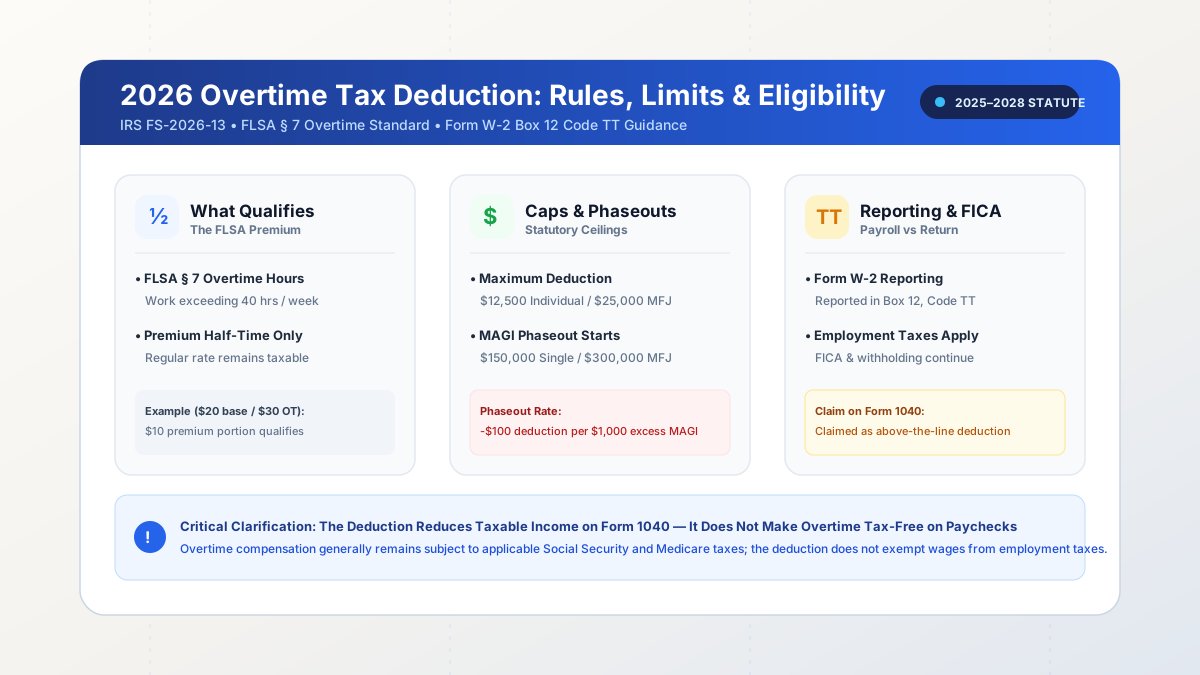
The most critical technical hurdle in claiming the 2026 overtime deduction is understanding what portion of your hourly pay qualifies as "qualified overtime compensation." Under IRS FS-2026-13 and Section 7 of the Fair Labor Standards Act (FLSA, 29 U.S.C. § 207), the deduction applies strictly and exclusively to the overtime premium pay that exceeds the employee's regular hourly rate.
When a non-exempt employee works more than 40 hours in a standard workweek, the FLSA mandates that the employer pay an overtime rate of at least one-and-one-half times (1.5x) the employee's regular rate of pay.
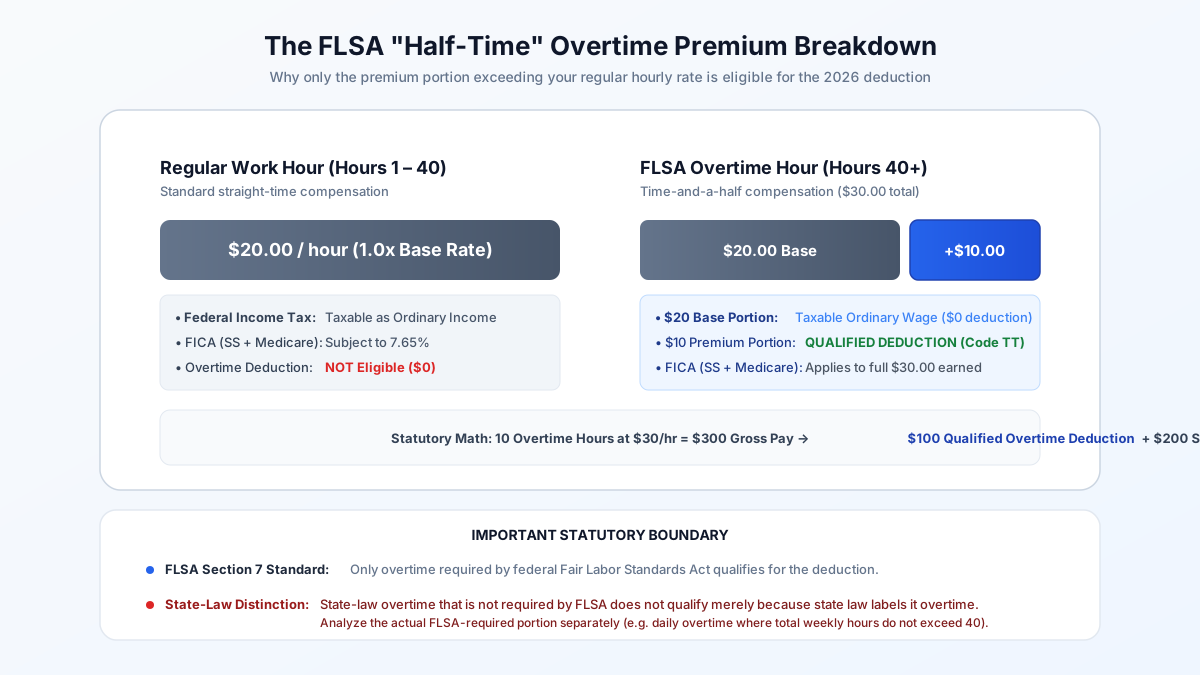
In a standard "time-and-a-half" overtime calculation: • **The Base Hourly Rate (1.0x):** Represents the standard wage paid for labor. This base portion is not exempt and remains fully subject to ordinary federal, state, and payroll taxation. • **The Overtime Premium (0.5x):** Represents the additional half-rate differential required by federal law for hours worked beyond 40 in a workweek. Only this 0.5x premium portion qualifies as a deductible amount under the statute.
For example, consider an electrician earning a regular wage of $30.00 per hour. When working overtime hours under FLSA mandates, the hourly rate increases to $45.00 per hour ($30.00 × 1.5). For every overtime hour worked: • $30.00 is base compensation (100% ordinary taxable wages). • $15.00 is the statutory overtime premium (eligible for the 2026 overtime deduction).
If that electrician works 10 overtime hours during a single week, their total overtime compensation is $450.00 ($45.00 × 10). Under IRS FS-2026-13, the qualified deductible overtime compensation is not $450.00—it is $150.00 ($15.00 premium × 10 hours). The remaining $300.00 is treated as standard taxable wage income.
State Overtime vs. Federal FLSA: The Critical Jurisdictional Distinction
A vital trap for hourly employees and multistate employers involves the interplay between state labor standards and federal tax law. Several states have overtime mandates that are significantly more generous or structurally different than federal FLSA rules.
For instance, California Labor Code Section 510 mandates overtime pay for any hours worked beyond 8 in a single workday, even if the worker's total weekly hours remain well below 40. Similarly, California, Alaska, and Nevada require daily overtime premiums, and some union contracts mandate premium pay for work performed on weekends, holidays, or consecutive work shifts.
Under IRS FS-2026-13, the IRS established an unequivocal jurisdictional standard: State-law overtime that is not required by FLSA does not qualify merely because state law labels it overtime. Analyze the actual FLSA-required portion separately.
If a California retail worker works a 10-hour shift on Monday and takes the remainder of the week off, the employer must pay 2 hours of daily overtime under California state law. However, because the employee only worked 10 total hours during the entire workweek—far below the federal 40-hour FLSA threshold—none of that premium pay is mandated by Section 7 of the FLSA. Consequently, none of that daily overtime premium qualifies for the federal 2026 overtime deduction.
Similarly, contractual overtime, shift differentials, hazard pay premiums, and sixth-day/seventh-day union penalty pay do not qualify unless the employee simultaneously satisfies the federal 40-hour weekly threshold. When running paycheck calculations on our hourly calculator, verify that your overtime hours meet federal FLSA thresholds before projecting tax deductions.
Statutory Dollar Caps, Filing Restrictions, and MAGI Phaseouts
To prevent high-income earners from exploiting overtime provisions and to limit federal revenue loss, Congress established strict annual dollar caps, filing status restrictions, and income-based phaseout thresholds for the 2026 tax year.
### 1. Annual Maximum Deduction Caps The maximum allowable deduction for qualified overtime premium compensation in 2026 is: • **Single, Head of Household, or Qualifying Surviving Spouse:** $12,500 maximum annual deduction • **Married Filing Jointly:** $25,000 maximum annual deduction (combined household limit) • **Married Filing Separately:** Ineligible ($0 deduction allowed)
### 2. Mandatory Joint Filing & Identification Requirements Married taxpayers must file a joint return to claim the qualified overtime deduction. Spouses filing under Married Filing Separately (MFS) are statutory prohibited from taking this deduction. Furthermore, the claiming taxpayer must possess a valid Social Security Number (SSN) issued on or before the due date of the return; an Individual Taxpayer Identification Number (ITIN) alone does not qualify for this specific provision.
### 3. Modified Adjusted Gross Income (MAGI) Phaseout Thresholds The deduction phases out systematically for taxpayers whose Modified Adjusted Gross Income exceeds specific income boundaries: • **Single and Head of Household:** The phaseout begins at $150,000 of MAGI and completely phases out at $275,000. • **Married Filing Jointly:** The phaseout begins at $300,000 of MAGI and completely phases out at $550,000.
The statutory phaseout rate is precisely calibrated: the allowable deduction cap is reduced by $100 for every $1,000 (or fraction thereof) that your MAGI exceeds the threshold. In percentage terms, this represents a 10% reduction rate on the maximum cap across the phaseout window.
For example, a single worker with a MAGI of $180,000 has exceeded the $150,000 threshold by $30,000. Dividing $30,000 by $1,000 yields 30 phaseout units. Multiplying 30 units by $100 results in a $3,000 cap reduction. The maximum overtime deduction this worker can claim drops from $12,500 to $9,500 ($12,500 − $3,000). Once MAGI hits $275,000 for single filers or $550,000 for joint filers, the allowable deduction is reduced to zero.
Employer Reporting: Form W-2 Box 12, Code TT and Schedule 1-A
Taxpayers cannot simply estimate or invent their overtime earnings when filing their annual tax returns. The IRS has established a rigorous third-party reporting mechanism to substantiate all deduction claims.
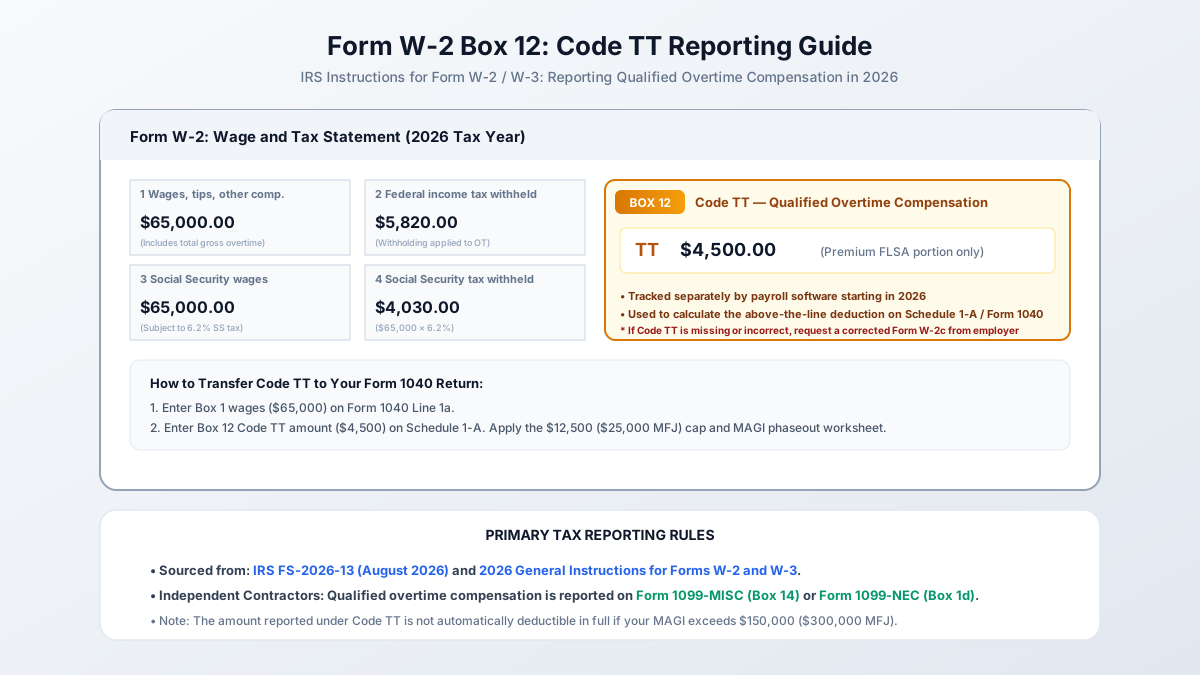
Under the 2026 Instructions for Forms W-2 and W-3, employers are required to track qualified FLSA overtime compensation and report the total amount in Box 12 using a newly established alpha code: • **Form W-2 Box 12, Code TT:** Qualified Overtime Compensation.
Box 12 Code TT reflects the total gross overtime wages paid to the employee for hours qualifying under FLSA Section 7. Employers are required to maintain payroll records verifying that reported amounts correspond strictly to non-exempt hours exceeding 40 per workweek. For independent contractors who occasionally receive premium payments reported on Form 1099-NEC or 1099-MISC, specialized reporting fields have been incorporated to verify contractually designated premium compensation.
When preparing your annual federal return, you do not deduct this amount directly on your W-2 wage line (Form 1040 Line 1a). Instead, you enter your Box 12 Code TT figures onto **IRS Schedule 1-A (Additional Deductions from Income)**, which calculates your allowable premium deduction after applying the statutory caps and MAGI phaseouts. The final computed deduction flows to Form 1040 Line 8a as an above-the-line deduction, reducing your Adjusted Gross Income (AGI).
This above-the-line treatment is extraordinarily beneficial: it reduces your AGI regardless of whether you choose to itemize deductions or take the standard deduction ($16,100 for Single filers or $32,200 for Married Filing Jointly in 2026).
The FICA Reality: Why Social Security & Medicare Still Apply
One of the most pervasive misconceptions surrounding the overtime tax deduction is the assumption that overtime paychecks will be completely free of all payroll taxes. Many workers expect that working overtime means keeping 100% of their gross earnings.
This assumption is legally incorrect. In IRS FS-2026-13, the IRS issued an explicit clarification regarding employment taxes: Overtime compensation generally remains subject to applicable Social Security and Medicare taxes; the qualified-overtime deduction does not exempt the overtime wages from employment taxes.
The qualified overtime deduction is strictly an income tax adjustment codified under the income tax provisions of the Internal Revenue Code. It has zero legal effect on the Federal Insurance Contributions Act (FICA) under IRC Chapter 21: • **Social Security Tax (6.2%):** Applies to all wages, including regular wages, overtime base wages, and overtime premium pay, up to the statutory 2026 Social Security wage base limit of $181,800. • **Medicare Tax (1.45%):** Applies to all wages without any dollar ceiling. • **Additional Medicare Tax (0.9%):** Applies to wage earnings exceeding statutory thresholds ($200,000 for Single, $250,000 for Married Filing Jointly).
Therefore, even when your overtime premium qualifies for a full 100% federal income tax deduction, your employer is legally obligated to withhold the standard 7.65% FICA tax (6.2% Social Security + 1.45% Medicare) from every dollar of overtime pay.
Furthermore, state and local income taxes are not automatically eliminated. Unless your individual state legislature passes conforming legislation adopting the federal overtime deduction into its state tax code, state income tax withholding will continue to apply to your entire overtime check. States with rolling conformity may adopt the deduction, while states with fixed-date conformity or decoupled tax codes will continue taxing overtime wages at standard rates.
The Paycheck Withholding Gap: Why Overtime Is Still Withheld at Work
If overtime premium pay is deductible from federal income taxes, why do employers continue taking federal income tax out of your overtime paychecks?
The answer lies in how modern automated payroll systems operate under IRS Publication 15-T. When your employer processes weekly or biweekly payroll, the payroll engine looks exclusively at the gross earnings for that specific pay period and references your existing Form W-4 elections. The payroll software does not and cannot know: 1. Whether your total annual overtime will stay below the $12,500 or $25,000 statutory caps. 2. What your spouse earns at another job. 3. Whether your household year-end MAGI will exceed the $150,000 or $300,000 phaseout thresholds. 4. Whether you will work overtime consistently throughout the entire calendar year.
Because of this uncertainty, IRS withholding regulations require employers to continue withholding federal income tax from overtime wages as supplemental wages or annualized ordinary income. If you do nothing, your employer will withhold income tax on your overtime as if the deduction did not exist, and you will receive your tax savings as a refund when you file Form 1040 in the spring.
### How to Adjust Your Form W-4 to Receive Overtime Savings Every Payday You are not required to wait a year to recover your money. If you are an hourly worker who consistently logs predictable overtime shifts, you can proactively capture your tax savings on every paycheck by updating your Form W-4: • **Step 4(b) (Deductions):** You can enter your projected annual qualified overtime deduction onto Line 4(b) of Form W-4. • When you enter a deduction on Line 4(b), IRS Publication 15-T instructs your employer's payroll software to reduce your annualized taxable wage base prior to calculating tax withholding. • For example, if you reliably earn $6,000 in qualifying FLSA overtime premiums per year, adding $6,000 to Line 4(b) reduces your per-paycheck tax withholding, spreading your tax savings evenly across all 26 biweekly pay periods (approximately $230 in annualized tax relief per pay period for a 22% bracket taxpayer).
Before adjusting Line 4(b), model your numbers through our comprehensive paycheck calculator and consult our step-by-step Form W-4 guide to avoid under-withholding penalties.
Comprehensive Numerical Example: Paycheck Impact for a Shift Worker
To illustrate exactly how the 2026 overtime deduction, FICA taxes, and annual tax reconciliations interact in practice, let us examine a realistic scenario featuring Marcus, a specialized medical technician in Ohio.
### Background Profile: • **Filing Status:** Single • **Regular Hourly Wage:** $32.00 per hour • **Standard Schedule:** 40 hours per week ($1,280.00 base weekly gross) • **Overtime Schedule:** 8 hours of FLSA overtime per week at time-and-a-half ($48.00/hr) • **Pay Frequency:** Biweekly (26 pay periods per year) • **Total Annual Overtime Hours:** 416 hours across the year
### Paycheck-Level Overtime Decomposition: On a biweekly basis, Marcus works 80 regular hours and 16 overtime hours: 1. **Regular Gross Wages:** 80 hours × $32.00 = $2,560.00 2. **Total Overtime Gross Wages:** 16 hours × $48.00 = $768.00 3. **Total Biweekly Gross Pay:** $3,328.00 4. **Decomposition of Overtime Pay under IRS FS-2026-13:** • Base Overtime Portion (1.0x): 16 hours × $32.00 = $512.00 (Standard taxable wages) • FLSA Overtime Premium (0.5x): 16 hours × $16.00 = $256.00 (Qualified deductible premium)
### Annual Totals & Cap Analysis: Across 26 biweekly pay periods in 2026: • Total Annual Gross Pay: $86,528.00 • Total Annual FLSA Overtime Premium (0.5x): 26 × $256.00 = $6,656.00 • Statutory Cap Check: $6,656.00 is well below the $12,500 Single cap. • MAGI Phaseout Check: Marcus's AGI of roughly $80,000 is far below the $150,000 Single phaseout threshold. Therefore, Marcus is entitled to the full $6,656.00 above-the-line deduction on Schedule 1-A.
### Net Tax Benefit Calculation: Marcus sits comfortably in the 22% federal marginal tax bracket: • **Federal Income Tax Savings:** $6,656.00 × 22% = $1,464.32 in direct annual income tax savings. • **FICA Tax Withheld on Overtime:** FICA taxes apply to the full $768.00 of biweekly overtime ($19,968.00 annually): - Social Security (6.2%): $19,968.00 × 0.062 = $1,238.02 - Medicare (1.45%): $19,968.00 × 0.0145 = $289.54 - Total Annual FICA on Overtime: $1,527.56
Marcus saves $1,464.32 in federal income taxes due to the new deduction. However, because FICA taxes continue to apply without exemption, Marcus still contributes $1,527.56 in payroll taxes on that overtime income. Marcus's net financial gain from the deduction is real and substantial, but it is not "tax-free" in the colloquial sense.
Frequently Asked Questions About the 2026 Overtime Tax Deduction
Authoritative answers to common questions regarding overtime tax regulations, Box 12 reporting, and paycheck calculations.
Does the 2026 overtime deduction mean I pay zero taxes on overtime hours?+
Can salaried employees claim the overtime tax deduction?+
What happens if I work double-time (2.0x) on holidays or weekends?+
Can I claim the overtime deduction if my spouse and I file separately?+
How do I see these overtime savings in my paycheck right now?+
See it in your paycheck
Use our free paycheck calculator to apply these rates to your actual salary.
Calculate my paycheck →