


What Is Form W-4 and Why Does It Control Your Take-Home Pay?
Form W-4 — officially titled the Employee's Withholding Certificate — is the foundational tax document you complete and submit to your employer's payroll department. It instructs your employer's payroll software on precisely how much federal income tax to withhold from each paycheck throughout the calendar year. Despite taking only minutes to complete, it remains one of the single most impactful financial forms in American working life. A minor oversight on Form W-4 can either divert thousands of dollars of your hard-earned earnings into an interest-free loan to the U.S. Treasury or trigger an unwelcome balance due — accompanied by potential IRS underpayment penalties — when you file your annual return.
To understand Form W-4, you must first recognize the fundamental operational principle of the U.S. payroll system: tax withholding is a prepayment mechanism, not your final tax liability. Your employer's payroll system does not calculate your final statutory tax under Internal Revenue Code Section 1. Instead, it follows computational algorithms published in IRS Publication 15-T (Federal Income Tax Withholding Methods). Publication 15-T annualizes the wages earned in a single pay period, subtracts statutory withholding allowances based on your Form W-4 elections, computes an annualized withholding figure using statutory wage bracket or percentage tables, and divides that figure by the number of annual pay periods (26 for biweekly, 24 for semimonthly, 52 for weekly).
The IRS completely redesigned Form W-4 in 2020, permanently eliminating the historic "withholding allowances" system that dated back to 1987. Under the modern 2026 Form W-4, there are no allowances to claim. Instead, the form uses transparent, direct dollar entries for dependents, additional non-job income, itemized or above-the-line deductions, and voluntary extra withholding. While this design is significantly more accurate when filled out thoughtfully, it provides far less margin for error when left on default settings. This guide walks through every step of the 2026 Form W-4, explaining the mathematics behind each entry and demonstrating how to configure your withholding with surgical precision.
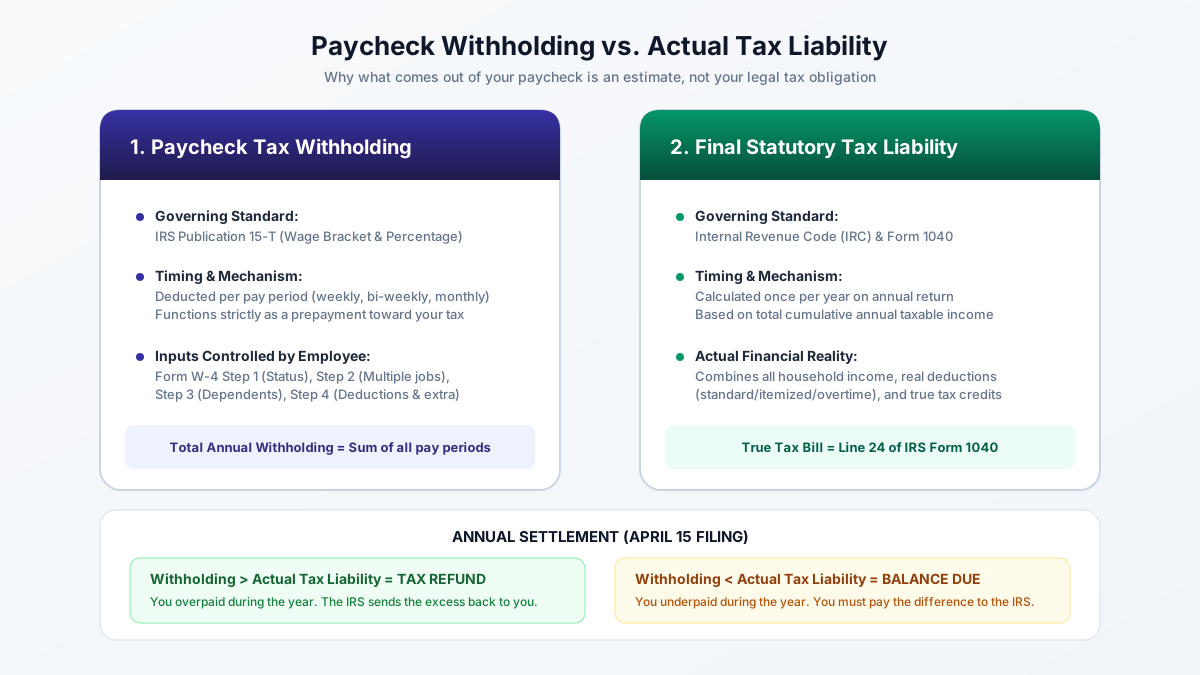
Withholding vs. Actual Tax Liability: The Critical Difference
A widespread misconception among American workers is that having more tax withheld from a paycheck increases your tax burden, or that having less withheld saves you money on taxes. In reality, your actual federal income tax liability is determined exclusively on IRS Form 1040 when you file your tax return following the close of the calendar year.
Your true tax liability is dictated by statutory parameters enacted by Congress and updated annually by the IRS under Revenue Procedure 2025-32: • Your total gross income from all sources (W-2 wages, 1099 independent earnings, capital gains, dividends, interest) • Your allowable deductions (either the 2026 standard deduction of $16,100 for Single/MFS, $32,200 for Married Filing Jointly, or $24,150 for Head of Household, plus eligible above-the-line adjustments) • Your progressive tax brackets (10%, 12%, 22%, 24%, 32%, 35%, 37%) applied strictly to taxable income • Your statutory tax credits (Child Tax Credit, Child and Dependent Care Credit, Clean Vehicle Credit, etc.)
Withholding, by contrast, is simply an ongoing installment payment toward that eventual liability. If your cumulative withholding across all paychecks exceeds your final tax liability on Form 1040 Line 24, the IRS issues the difference as a tax refund. If your cumulative withholding is less than your final liability, you must remit the balance due by the April tax filing deadline.
Understanding this distinction gives you complete financial agency. You do not need to settle for an enormous $4,000 refund in April — which represents roughly $154 per biweekly paycheck that could have been used to pay down high-interest debt, invest in a high-yield savings account, or cover family living costs. Conversely, you can prevent unexpected year-end tax bills by ensuring your Form W-4 accurately mirrors your complete household financial picture.
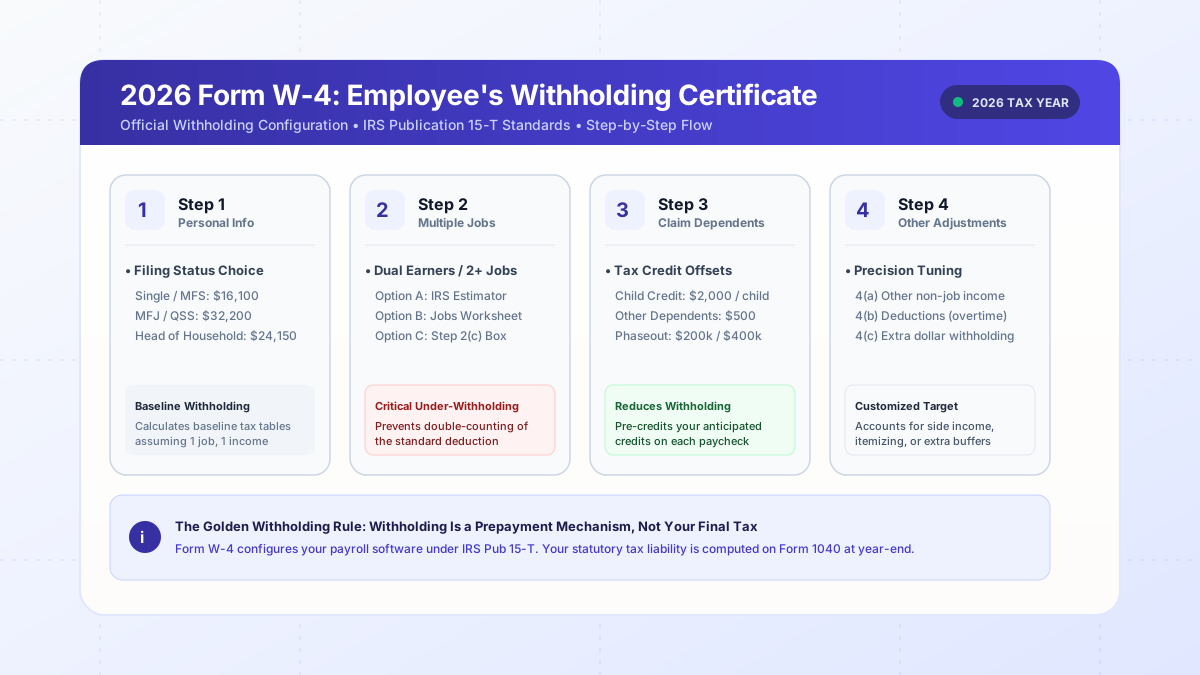
Step 1: Enter Personal Information & Select Filing Status
Step 1 captures your basic identification — full legal name, permanent address, Social Security Number — and requires you to select your tax filing status. Your filing status dictates the baseline tax bracket thresholds and standard deduction that your employer's payroll software will automatically apply under IRS Publication 15-T.
For 2026, the standard deduction built into the baseline withholding algorithms is: • **Single or Married Filing Separately:** $16,100 built-in allowance • **Married Filing Jointly or Qualifying Surviving Spouse:** $32,200 built-in allowance • **Head of Household:** $24,150 built-in allowance
**The Single / Married Filing Separately Box:** This is the most conservative withholding selection. Choosing Single applies narrower tax brackets and the $16,100 standard deduction. If you are an unmarried worker with one job and no other substantial income, checking this box produces dependable, accurate withholding that rarely results in an underpayment penalty.
**The Married Filing Jointly Box:** Checking Married Filing Jointly signals payroll software to apply the wider married tax brackets and the full $32,200 joint standard deduction. However, here lies the single most frequent and costly payroll mistake in the United States: when both spouses work, and both select "Married Filing Jointly" on their respective W-4s without completing Step 2, each employer independently applies the full $32,200 standard deduction and lower joint brackets. Across the household, $64,400 in income is treated as untaxed, leading to substantial under-withholding and massive surprise tax bills in April.
**The Head of Household Box:** Reserved for unmarried individuals who pay more than half the cost of maintaining a home for a qualifying child or dependent relative. Head of Household provides more favorable withholding tables than Single, reflecting the $24,150 standard deduction and wider 10% and 12% brackets.
Step 2: Multiple Jobs or Working Spouse (Crucial for Dual Earners)
Step 2 is mandatory if you hold more than one job simultaneously, or if you are married filing jointly and your spouse also earns taxable wage income. If you fall into either category and skip Step 2, your household is virtually guaranteed to under-withhold taxes.
Because each employer processes payroll in total isolation, neither employer knows about the income earned at your other position. Employer A assumes its wages represent your total household income and applies the standard deduction and low brackets. Employer B does the exact same thing. When you combine those incomes on your joint tax return, the upper portion of your earnings pushes into higher marginal tax brackets (such as 22% or 24%) that were never taxed at that rate during the year.
The IRS provides three distinct methods to complete Step 2:
**Option A: The IRS Tax Withholding Estimator (Recommended by IRS)** Visit the official tool at irs.gov/W4app. The estimator evaluates your combined household wages, year-to-date withholding, bonuses, and deductions, and produces an exact dollar amount to enter on Line 4(c) of the higher-paying job's W-4. This method provides the highest degree of mathematical precision and is particularly valuable if one spouse earns significantly more than the other or if income fluctuates.
**Option B: The Multiple Jobs Worksheet (Form W-4 Page 3)** If you prefer not to use an online tool, you can complete the paper worksheet on page 3 of Form W-4. The worksheet uses a two-earner matrix to determine the additional annual tax liability created by stacking the two incomes, divides that figure by the number of pay periods remaining in the year, and instructs you to enter that dollar figure on Line 4(c) of the W-4 for the highest-paying job. All other W-4s should leave Steps 2, 3, and 4 blank.
**Option C: The Step 2(c) Checkbox** If there are exactly two jobs in the household with roughly similar pay (the IRS guideline is that the lower-paying job earns at least 50% of the higher-paying job), you can simply check the box in Step 2(c) on the W-4s for **both** jobs. Checking this box cuts the standard deduction and bracket widths in half for withholding calculations, effectively applying single-filer withholding rates to joint returns. While simple, do not use Option C if the two incomes differ widely, as it can result in significant over-withholding.
Step 3: Claim Dependents & Tax Credits
Step 3 allows you to directly reduce the federal income tax withheld from your paychecks throughout the year by accounting for the Child Tax Credit and the Credit for Other Dependents. Rather than waiting for an annual refund in April, Step 3 converts your expected tax credits into immediate cash flow in each paycheck.
Under the 2026 tax rules: • **Qualifying Children Under Age 17:** Multiply the number of qualifying children by **$2,000**. • **Other Qualifying Dependents:** Multiply the number of other dependents (children aged 17–18, full-time college students aged 19–23, or elderly dependent parents) by **$500**. • Add the amounts together and enter the total on Line 3.
**How Payroll Software Processes Step 3:** When an employee enters $2,000 on Line 3 of Form W-4, the employer's payroll software divides that $2,000 across the annual pay frequency. On a biweekly payroll schedule (26 pay periods), payroll software reduces federal income tax withholding by exactly **$76.92 per paycheck** ($2,000 ÷ 26).
**Critical Income Phaseout Warning:** The Child Tax Credit phases out at higher income levels: Modified Adjusted Gross Income (MAGI) over **$200,000 for single filers** or **$400,000 for married couples filing jointly**. The credit is reduced by $50 for each $1,000 (or fraction thereof) by which your MAGI exceeds these statutory thresholds. If your household income exceeds these limits, claiming the full $2,000 per child in Step 3 will cause your employer to under-withhold, generating a tax balance due at year-end. If your income falls into the phaseout zone, use the IRS Withholding Estimator to determine the prorated credit amount.
Note: In a dual-income household, claim dependent credits on the Form W-4 for the **highest-paying job only**. Do not claim the same dependents on multiple W-4s, as doing so will double-count the credit and cause severe under-withholding.
Step 4: Optional Adjustments (Other Income, Deductions & Extra Withholding)
Step 4 is optional, but it provides the precision controls necessary to align your withholding with complex financial circumstances. It contains three distinct sub-sections:
**Step 4(a) — Other Income (Not from Jobs):** Enter the total estimated non-wage taxable income you anticipate receiving during 2026 from which no tax will be automatically withheld. This includes interest income, stock dividends, capital gains, taxable retirement distributions, rental property profits, and freelance or gig-economy earnings. *How it works:* Entering $5,000 on Line 4(a) signals payroll software to calculate withholding as if your job paid an additional $5,000 annually. This absorbs the tax liability on your side income through your regular W-2 paycheck, eliminating the need to write quarterly estimated tax checks to the IRS.
**Step 4(b) — Deductions:** Enter estimated deductions that exceed the standard deduction. If you itemize deductions (mortgage interest, state and local taxes up to the statutory cap, charitable donations, medical expenses) and your projected total exceeds the 2026 standard deduction ($16,100 Single / $32,200 MFJ), enter the excess amount on Line 4(b). You can also include above-the-line deductions such as deductible student loan interest or eligible retirement contributions. *How it works:* Entering $4,000 on Line 4(b) reduces your annualized withholding base by $4,000, increasing your net pay by dividing the tax savings evenly across each paycheck.
**Step 4(c) — Extra Withholding:** Enter any additional flat dollar amount you wish to have withheld from **each paycheck**. Unlike Lines 4(a) and 4(b) which represent annual amounts, Line 4(c) is a per-pay-period figure. *How it works:* If you enter $50 on Line 4(c) on a biweekly payroll schedule, your employer deducts an extra $50 from every check ($1,300 over the course of 26 pay periods). This is the simplest tool for eliminating an anticipated tax bill or buffering against fluctuating commission income.
Step 4(b) Planning: Accounting for New 2026 Deductions & Overtime
A significant update for 2026 is the ability to account for new above-the-line deductions directly on Form W-4 Step 4(b).
Under IRS guidance (including IRS FS-2026-13, updated August 2026), eligible hourly workers who earn substantial qualified overtime compensation can factor their anticipated above-the-line overtime deduction into Step 4(b). Under Internal Revenue Code Section 63, the qualified overtime deduction allows eligible employees to deduct up to $12,500 ($25,000 for married couples filing jointly) of the premium portion of overtime pay required under the Fair Labor Standards Act (FLSA), subject to MAGI phaseout thresholds ($150,000 Single / $300,000 MFJ).
Because employers are required by IRS Publication 15-T to continue standard federal tax withholding on gross overtime wages during the payroll cycle, an employee who regularly works overtime will build up substantial excess withholding over the year. By completing the Deductions Worksheet on page 3 of Form W-4 and incorporating their anticipated qualified overtime deduction on Line 4(b), employees can proactively lower their per-paycheck withholding.
**Example of Step 4(b) Optimization:** A single worker anticipates $6,000 in qualified FLSA overtime premium pay in 2026 (eligible for Box 12, Code TT on Form W-2). Their MAGI is under $150,000, meaning they qualify for the full $6,000 deduction. • Standard Deduction: $16,100 • Additional Above-the-Line Deduction: $6,000 • Step 4(b) Entry: $6,000 • Result on Biweekly Paycheck: Federal taxable wages are reduced by approximately $230.77 per pay period ($6,000 ÷ 26), preserving roughly $28 to $51 in take-home pay on every paycheck (depending on marginal bracket) rather than waiting for a refund check in April 2027.
Estimated-Tax Safe Harbors & Avoiding Underpayment Penalties
When modifying Form W-4 to reduce withholding, taxpayers must be mindful of IRS underpayment penalties under Internal Revenue Code Section 6654. While Form W-4 allows you to customize your withholding, submitting an inaccurate form that severely under-withholds can trigger IRS penalties if your year-end withholding falls short of statutory thresholds.
The estimated-tax safe harbors that can generally protect taxpayers from an underpayment penalty include: 1. **The 90% Current-Year Rule:** You owe no penalty if your total federal tax withholding and timely estimated payments equal at least **90% of your total tax liability for the current tax year (2026)**. 2. **The 100% Prior-Year Rule:** You owe no penalty if your total withholding equals at least **100% of the total tax shown on your prior-year tax return (2025 Form 1040 Line 24)**, provided your return covered all 12 months. 3. **The 110% High-Income Rule:** If your Adjusted Gross Income (AGI) on your 2025 return exceeded **$150,000** ($75,000 if married filing separately), the prior-year safe harbor threshold increases to **110% of your 2025 tax liability**. 4. **The $1,000 De Minimis Rule:** Regardless of percentages, no underpayment penalty is assessed if the net tax balance due on your return (after subtracting withholding and credits) is less than **$1,000**.
Form W-4 adjustments should always be calibrated to ensure your annual withholding satisfies at least one of these safe harbors. If your income rises sharply due to a promotion, capital gain, or business profit, adjusting Line 4(c) for extra withholding ensures you remain shielded from underpayment interest charges.
When Should You Update Your W-4?
Form W-4 does not expire annually for regular employees; an existing W-4 remains active with your employer indefinitely until you submit a revised version. However, life and financial milestones fundamentally alter your tax reality. The IRS recommends reviewing your withholding annually and submitting an updated Form W-4 within 30 days of any major life event:
• **Marriage or Legal Separation:** Moving from Single to Married Filing Jointly alters your tax bracket widths and doubles your standard deduction to $32,200. Updating your form prevents substantial over-withholding (if single-earner) or severe under-withholding (if dual-earner). • **Birth or Adoption of a Child:** Each new child under age 17 creates eligibility for a $2,000 Child Tax Credit. Entering this in Step 3 immediately increases each paycheck's take-home pay by approximately $77 biweekly. • **Purchasing a Home:** Taking on significant mortgage interest and property taxes may push your itemized deductions beyond the $16,100 / $32,200 standard deduction, creating eligible deductions for Step 4(b). • **Starting a Second Job or Side Business:** Multiple revenue streams push income into higher marginal brackets. Updating Step 2 or adding extra withholding in Step 4(c) offsets non-wage tax obligations. • **Major Changes in Overtime Hours:** Hourly workers seeing significant shifts in FLSA overtime hours should evaluate whether to adjust Step 4(b) to capture the 2026 qualified overtime deduction. • **Receiving a Large Refund or Substantial Tax Bill:** A refund over $2,000 indicates you gave the IRS an unnecessary interest-free loan. A tax bill over $1,000 indicates under-withholding risk. Both scenarios can be remedied with a 5-minute W-4 adjustment.
Claiming Exempt From Federal Withholding: Strict Rules
Claiming "Exempt" on Form W-4 instructs your employer to withhold exactly $0 in federal income tax from your paychecks. Because this completely eliminates income tax prepayment, the IRS enforces rigorous statutory criteria under IRC § 3402(n).
You may claim exemption from federal withholding **only if BOTH of the following conditions are met**: 1. **Prior Year Condition:** For the previous tax year (2025), you had zero federal income tax liability (your total tax on Form 1040 Line 24 was zero, or you received a full refund of all federal income tax withheld because your income was below the filing threshold). 2. **Current Year Condition:** For the current tax year (2026), you reasonably expect to have zero federal income tax liability (your total gross income will be less than the standard deduction of $16,100 for single filers, or your non-refundable credits will exceed your tax liability).
To claim exempt, write the word **"EXEMPT"** in the designated space below Step 4(c) and complete Steps 1 and 5. Do not complete Steps 2, 3, or 4.
**The FICA Rule:** Claiming exempt applies **exclusively to federal income tax**. It has zero effect on FICA payroll taxes. Your employer must continue withholding 6.2% Social Security and 1.45% Medicare taxes regardless of your W-4 exempt election.
**The February 15 Expiration Mandate:** Unlike regular W-4 forms that remain active indefinitely, an exempt W-4 certificate **legally expires on February 15 of every year**. If you qualify for exemption in 2026, you must submit a brand new Form W-4 by February 15. If you fail to submit a new form, federal regulations require your employer to immediately begin withholding tax as if you are Single with zero adjustments — the highest default withholding rate.
State Withholding Certificates: Separate From Federal W-4
Your federal Form W-4 governs only federal income tax withholding. In the majority of U.S. states, state income tax withholding is managed through independent state withholding certificates with distinct deduction rules and filing forms.
**States Requiring Independent State Withholding Forms:** Many populous states do not accept federal Form W-4 elections for state withholding. During employer onboarding, workers in these states must complete both federal Form W-4 and the corresponding state form: • **California:** Form DE 4 (Employee's Withholding Allowance Certificate) — handles California personal exemption credits and state withholding allowances. • **New York:** Form IT-2104 (Employee's Withholding Allowance Certificate) — calculates New York State, New York City, and Yonkers resident/non-resident withholding. • **Illinois:** Form IL-W-4 (Employee's and other Payee's Illinois Withholding Allowance Certificate and Instructions). • **Massachusetts:** Form M-4 (Massachusetts Employee's Withholding Exemption Certificate). • **Pennsylvania:** PA Form REV-419 (Employee's Nonwithholding or Exemption Certificate).
**No-Income-Tax States:** In states with no broad-based personal wage income tax — Alaska, Florida, Nevada, New Hampshire, South Dakota, Tennessee, Texas, Washington, and Wyoming — there are no state withholding forms. Employees in these jurisdictions complete only federal Form W-4.
See Your W-4 Elections Reflected in Real Paycheck Math
The fastest way to verify how a change in filing status, dependent credits, or deduction entries impacts your take-home pay is to model your earnings through a calibrated payroll calculation engine.
Our 2026 paycheck calculator incorporates all 2026 IRS Publication 15-T wage bracket algorithms, federal tax brackets, Social Security wage base thresholds ($184,500), and all 51 state tax codes.
Frequently Asked Questions
Do I need to submit a new Form W-4 every year?+
What happens if I never submit a Form W-4 to my employer?+
Can my employer see or edit the information on my Form W-4?+
My spouse and I both work. What is the most accurate way to set our W-4s?+
Can I use Form W-4 Step 4(b) to account for the 2026 overtime deduction?+
Will completing Form W-4 accurately guarantee that I never owe taxes?+
Official Government Sources & Primary References
Every standard, threshold, and payroll procedure in this guide is derived directly from authoritative U.S. government releases:
• **IRS Form W-4 (2026):** Employee's Withholding Certificate — [irs.gov/FormW4](https://www.irs.gov/forms-pubs/about-form-w-4) • **IRS Publication 15-T (2026):** Federal Income Tax Withholding Methods — [irs.gov/Pub15T](https://www.irs.gov/forms-pubs/about-publication-15-t) • **IRS Revenue Procedure 2025-32:** 2026 Annual Inflation Adjustments & Standard Deductions • **IRS Fact Sheet FS-2026-13 (August 2026):** Qualified Overtime Compensation Deduction Guidance • **Internal Revenue Code § 3402:** Income Tax Collected at Source & Withholding Procedures • **Internal Revenue Code § 6654:** Failure by Individual to Pay Estimated Income Tax (Safe Harbor Rules) • **IRS Tax Withholding Estimator:** [irs.gov/W4app](https://www.irs.gov/individuals/tax-withholding-estimator)
See it in your paycheck
Use our free paycheck calculator to apply these rates to your actual salary.
Calculate my paycheck →