

Why Your 2026 Paycheck Withholding May Change (And How to Fix It)

Digital Strategist & Tax Content Researcher
Santosh is a digital strategist with over 10 years of experience building user-centric financial web platforms. He personally reviews every calculator update against current IRS publications and state DOR releases to ensure accuracy before anything goes live.
On This Page
There is few things more unsettling on payday than opening your direct deposit notification or reviewing your pay stub to discover that your net take-home pay has suddenly decreased—even though your gross salary, hourly wage, and scheduled hours remained completely unchanged. Every January and throughout the calendar year, millions of American workers experience sudden, confusing fluctuations in their net paychecks. Workers often suspect an administrative error by their payroll department or worry that a clandestine tax hike was enacted overnight. In reality, paycheck withholding changes are almost always driven by precise, predictable mechanics embedded in federal tax law, annual statutory cost-of-living adjustments, social insurance resets, and employer open-enrollment benefit deductions. Understanding why your 2026 paycheck withholding shifted is essential not only for peace of mind, but also for maintaining accurate tax calibration across the entire calendar year. This comprehensive diagnostic guide examines the primary drivers of 2026 paycheck changes, details how the annual Social Security wage base reset works, explores new benefit caps under IRS Notice 2025-67, and provides a clear troubleshooting roadmap to help you regain complete control over your take-home pay.
Calculate Your Take-Home Pay
Enter your salary, state, and deductions — get your estimated net pay in under 100ms.
The 6 Primary Drivers of Paycheck Withholding Changes in 2026
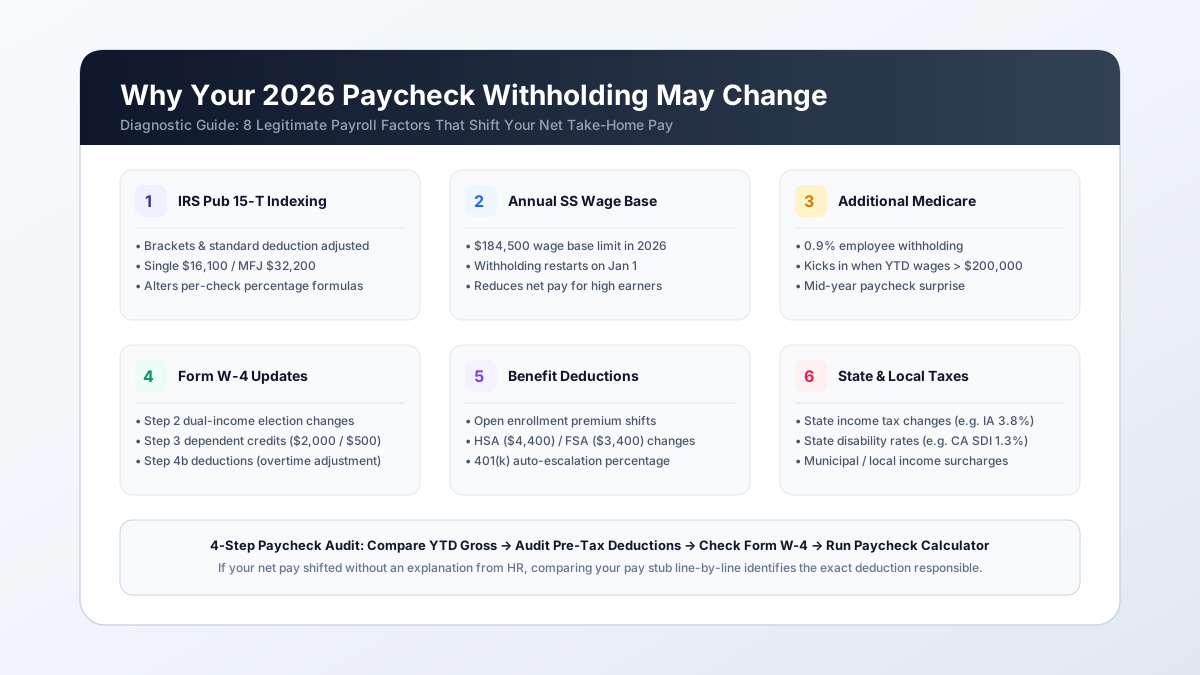
When your net pay changes unexpectedly, the culprit almost invariably lies in one of six distinct categories. Payroll software does not apply arbitrary percentage deductions; every dollar withheld from your gross pay is dictated by a specific federal, state, or company benefit rule.
The six primary drivers affecting American paychecks in 2026 include:
1. IRS Annual Inflation Adjustments (Rev. Proc. 2025-32): Annual shifts in federal tax bracket thresholds and standard deduction allowances under IRS Publication 15-T.
2. Social Security Wage Base Resets (SSA Limit $181,800): The annual restart of the 6.2% Social Security tax every January for upper-middle and high earners.
3. Open Enrollment Benefit Deductions (Notice 2025-67 & Rev. Proc. 2025-19): Increased pre-tax contributions for 401(k), HSA, FSA, and updated employer healthcare premiums.
4. State and Local Tax Code Updates: State income tax bracket changes, flat-rate phase-ins, or updated state disability and family leave premiums.
5. Irregular Supplemental Pay & Annualization Spikes: Overtime, performance bonuses, or commissions causing Publication 15-T to temporarily project your annual income into higher tax brackets.
6. Outdated Form W-4 Elections: Life milestones (marriage, a spouse returning to work, a child aging out of tax credits) that alter your optimal withholding settings.
By methodically reviewing your pay stub line by line against these six factors, you can immediately pinpoint the exact cause of any paycheck shift.
The January Social Security Reset: Why High Earners See Take-Home Drops
One of the most common causes of a sudden paycheck drop between December and January affects professionals earning above $175,000. Workers frequently celebrate a significant boost in take-home pay during October or November, only to experience an abrupt pay cut on their first paycheck in January.
The explanation lies in the statutory mechanics of the Federal Insurance Contributions Act (FICA):
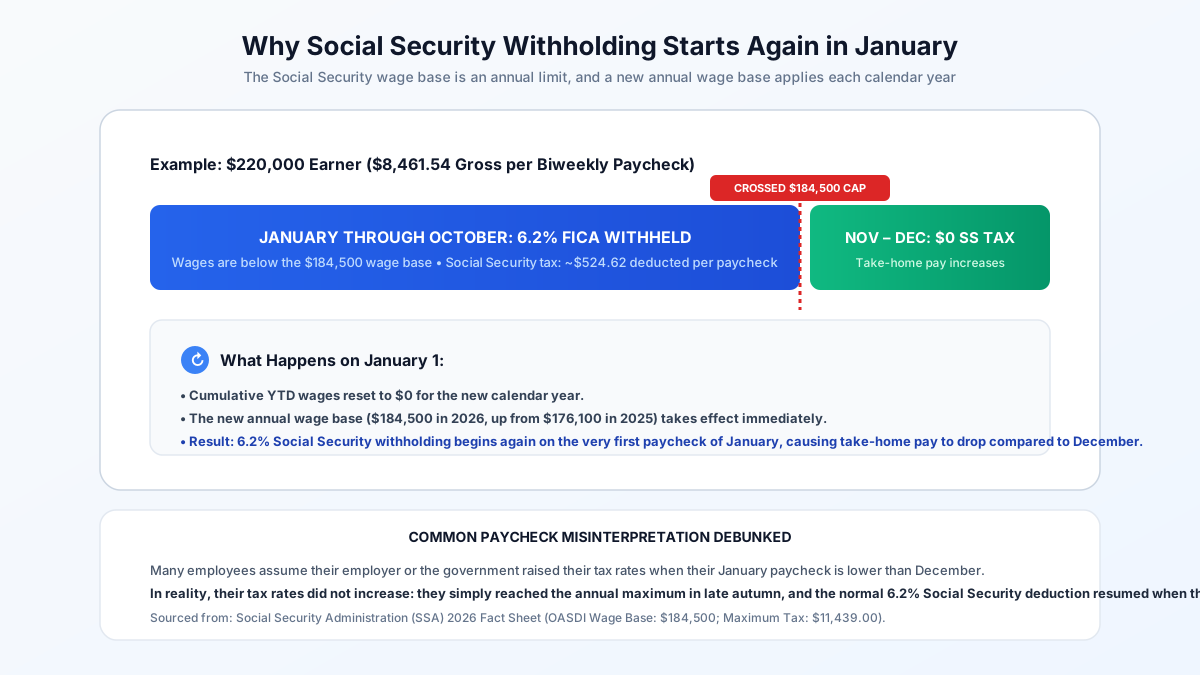
Why Social Security withholding can start again in January: the Social Security wage base is an annual limit, and a new annual wage base applies each calendar year.
Under federal statute, the 6.2% Social Security payroll tax does not apply to infinite earnings. Instead, it is capped at an annual statutory threshold determined by the Social Security Administration based on the national average wage index:
• 2025 Social Security Wage Base: $176,100 (Maximum tax: $10,918.20)
• 2026 Social Security Wage Base: $181,800 (Maximum tax: $11,271.60)
When an employee's cumulative year-to-date earnings surpass the wage base limit in late autumn, their employer's payroll software automatically shuts off the 6.2% Social Security deduction for the remainder of that calendar year. For an employee earning $240,000 annually ($10,000 per biweekly check), this means their paycheck suddenly increases by $620.00 per pay period once the cap is hit.
However, the wage base is strictly an annual limit. On January 1 of each new calendar year, the year-to-date earnings counter resets to zero. Your employer must immediately resume withholding the 6.2% Social Security tax on every dollar of gross wages until your cumulative earnings hit the new 2026 threshold of $181,800. What feels like an unexpected pay reduction in January is simply the normal, legal resumption of mandatory federal payroll tax withholding.
IRS Bracket Adjustments: How Publication 15-T Calibrates Withholding
Even workers whose earnings fall well below the Social Security wage base frequently notice small dollar differences in their net pay starting in January. This shift is caused by IRS inflation indexing.
Under Internal Revenue Code Section 1(f) and IRS Revenue Procedure 2025-32, the IRS annually adjusts federal income tax brackets and standard deductions to prevent "bracket creep"—a phenomenon where inflation pushes taxpayers into higher tax brackets without any real increase in purchasing power.
For 2026, the statutory standard deductions used by employers in IRS Publication 15-T withholding algorithms are:
• Single or Married Filing Separately: $16,100 (up from $15,000 in 2025)
• Married Filing Jointly: $32,200 (up from $30,000 in 2025)
• Head of Household: $24,150 (up from $22,500 in 2025)
Because the standard deduction and tax bracket boundaries expanded for 2026, an employee earning the exact same $75,000 salary in 2026 as in 2025 will actually see slightly less federal income tax withheld from each paycheck, resulting in a modest boost in net pay of roughly $10 to $25 per paycheck.
Conversely, if your employer implemented an annual cost-of-living raise (e.g., a 3.5% salary increase) that took effect on January 1, your gross pay increased, but the additional income was withheld at your top marginal tax bracket rate (such as 22% or 24%). This can make the net paycheck increase feel noticeably smaller than expected.
Open Enrollment Changes: Retirement, Health, and Pre-Tax Benefit Limits
For the vast majority of salaried and corporate workers, the single largest reason a January paycheck differs from a December paycheck is the implementation of new employee benefits selected during autumn Open Enrollment.
Benefit selections and statutory contribution limits reset every January 1:
### 1. Retirement Plan Contributions (401k, 403b, 457)
Under IRS Notice 2025-67, the annual elective deferral limit for employee contributions to 401(k), 403(b), and most 457 plans increased for 2026:
• Standard Elective Deferral Limit: $23,500 per year.
• Age 50+ Catch-Up Contribution: Additional $7,500 (total $31,000).
• SECURE 2.0 Special Age 60–63 Catch-Up: Enhanced catch-up limit of $11,250 (total $34,750).
If you enrolled in an "auto-escalation" feature that automatically increases your retirement contribution by 1% of salary every January, or if you manually increased your percentage contribution to maximize the new $23,500 limit, your pre-tax deduction increased, directly reducing your take-home pay.
### 2. Health Savings Account (HSA) & Flexible Spending Account (FSA)
Under IRS Revenue Procedure 2025-19, contribution caps for high-deductible health plans were indexed upward for 2026:
• HSA Self-Only Coverage: $4,300 annual limit.
• HSA Family Coverage: $8,550 annual limit (plus $1,000 catch-up for individuals age 55+).
• Healthcare Flexible Spending Account (FSA): $3,300 annual limit.
### 3. Employer Healthcare Premium Cost Sharing
Health insurance premium increases typically take effect on the first paycheck of the new plan year. If your employer's health insurance premiums rose by 6% to 10% and the company passed a portion of that cost onto employees, your payroll deduction for medical, dental, or vision coverage increased, lowering your net pay even if your tax withholding remained unchanged.
State Tax Reforms and Mandated State Payroll Programs
State legislatures frequently enact tax code changes that take effect on January 1 of each calendar year. Depending on where you reside and work, state deductions can significantly alter your paycheck.
Key state-level factors influencing 2026 paychecks include:
• Flat-Rate Income Tax Transitions: States like Georgia, Iowa, and North Carolina have implemented statutory phased reductions in their individual income tax rates for 2026, slightly increasing net take-home pay for residents.
• State Standard Deduction and Exemption Indexing: States with progressive brackets (such as California, New York, and Minnesota) annually index their tax brackets to state inflation metrics, modifying state withholding tables.
• State Disability Insurance (SDI) and Paid Family Leave (PFL): In states like California, New York, New Jersey, Washington, and Massachusetts, mandatory state disability or family leave insurance rates and taxable wage caps reset on January 1. For example, California SDI applies to all covered wages without an annual wage ceiling, and statutory rate adjustments immediately impact net take-home pay.
When troubleshooting paycheck variations, always compare the "State Tax" and "State Disability / SUI" lines on your current pay stub against a pay stub from the prior year.
Step-by-Step Diagnostic Checklist: How to Audit Your Pay Stub
If your paycheck looks different and you cannot immediately identify why, follow this systematic four-step diagnostic procedure using two consecutive pay stubs (or your first paycheck of the new year compared to your last paycheck of the prior year):
### Step 1: Compare Total Gross Pay
Examine the top of your pay stub. Is your gross pay identical? If gross pay changed, check regular hours, hourly rates, overtime hours, commissions, bonuses, or paid time off (PTO) cash-outs.
### Step 2: Compare Pre-Tax Deductions
Look at your pre-tax deduction section:
• 401(k) / 403(b) retirement contributions
• Health insurance (medical, dental, vision)
• Health Savings Account (HSA) or Flexible Spending Account (FSA)
• Pre-tax commuter benefits
If any pre-tax deduction increased, your take-home pay will be lower—though your taxable income is also lower, saving you money on income taxes.
### Step 3: Compare Statutory Tax Withholdings
Evaluate each tax line item separately:
• Federal Income Tax (FIT): Did it change? If your gross and pre-tax deductions are unchanged, check whether your employer implemented 2026 Publication 15-T tables or if an old W-4 was recently updated.
• Social Security (6.2%): Did withholding suddenly resume after stopping late last year?
• Medicare (1.45%): Is it exactly 1.45% of Medicare wages (plus 0.9% if year-to-date wages exceed $200,000)?
• State Income Tax (SIT): Did your state tax rate or withholding allowances change?
### Step 4: Compare Post-Tax Deductions
Inspect any voluntary post-tax deductions: Roth 401(k) contributions, supplemental life insurance, union dues, charitable payroll deductions, or wage garnishments.
The table below illustrates a real-world $85,000 corporate salary pay stub comparing December 2025 to January 2026, demonstrating how multiple subtle adjustments interact.
Safe Harbors & When to Submit an Updated Form W-4
If your paycheck analysis reveals that you are under-withholding taxes—or if your take-home pay is significantly lower than necessary because too much tax is being withheld—you should submit an updated Form W-4 to your payroll department.
### Avoiding IRS Underpayment Penalties with Safe Harbors
When adjusting your Form W-4 to increase your take-home pay, you must ensure that your total annual withholding satisfies federal penalty safe harbors under Internal Revenue Code Section 6654.
The estimated-tax safe harbors that can generally protect taxpayers from an underpayment penalty include:
• Current Year 90% Rule: Paying in at least 90% of your total tax liability for the 2026 tax year through payroll withholding and timely estimated tax payments.
• Prior Year 100% Rule: Paying in at least 100% of your total tax liability reported on your 2025 Form 1040 (Line 24).
• High-Income 110% Rule: If your Adjusted Gross Income (AGI) on your prior-year 2025 tax return exceeded $150,000 ($75,000 if Married Filing Separately), you must pay in at least 110% of your 2025 tax liability to qualify for the prior-year safe harbor.
If your withholding satisfies any of these safe harbors, the IRS will not assess an underpayment penalty, even if you end up owing a balance due when filing your return.
### Key Milestones Requiring an Immediate Form W-4 Review
Submit a new Form W-4 whenever any of the following life events take place:
• Marriage or Divorce: Changing your filing status from Single to Married Filing Jointly drastically changes withholding tables.
• Working Spouse Changes: If your spouse starts or stops working, or receives a major promotion, complete Step 2 of Form W-4.
• New Child or Dependent: Claim the $2,000 Child Tax Credit on Step 3 to immediately reduce your per-paycheck tax withholding and increase take-home pay.
• Substantial Overtime Shifts: Hourly workers earning qualified overtime can adjust Step 4(b) (Deductions) to reflect the 2026 overtime deduction during the year.
Use our free [Salary Paycheck Calculator](/calculators/salary) to model your withholding adjustments before submitting your new form, and consult our complete [Form W-4 Withholding Guide](/resources/w4-withholding-guide-2026) for line-by-line instructions.
Tip
A drop in your net paycheck does not always mean you lost money. When take-home pay decreases because you increased 401(k) or HSA contributions, every diverted dollar remains 100% your money, grows tax-deferred, and lowers your federal and state tax bills.
Frequently Asked Questions
The most common reasons are: (1) higher retirement or HSA contributions from open enrollment elections, (2) annual increases in employer health insurance premiums, or (3) the January reset of the 6.2% Social Security tax if your earnings exceeded the wage base late last year. Review your pay stub deductions line-by-line to isolate the exact change.
Calculate Your Take-Home Pay
Enter your salary, state, and deductions — get your estimated net pay in under 100ms.
Related Articles
Federal Taxes
How Federal Income Tax Is Calculated
Federal income tax uses progressive brackets — you only pay each bracket's rate on the income that falls within it, not your entire salary.
Read articleFederal Taxes
What Is FICA Tax? Social Security and Medicare Explained
FICA taxes fund Social Security and Medicare. At 7.65% flat (matched by your employer), they apply to almost all earned income.
Read articleFederal Taxes
How Tax Brackets Work in the US
Tax brackets are widely misunderstood. Only the income within each bracket is taxed at that rate — not your entire salary.
Read articleGet Salary & Tax Tips
Weekly insights on pay, taxes, and maximizing your take-home.