

No Tax on Overtime in 2026? Why Taxes Are Still Coming Out of Your Paycheck

Digital Strategist & Tax Content Researcher
Santosh is a digital strategist with over 10 years of experience building user-centric financial web platforms. He personally reviews every calculator update against current IRS publications and state DOR releases to ensure accuracy before anything goes live.
On This Page
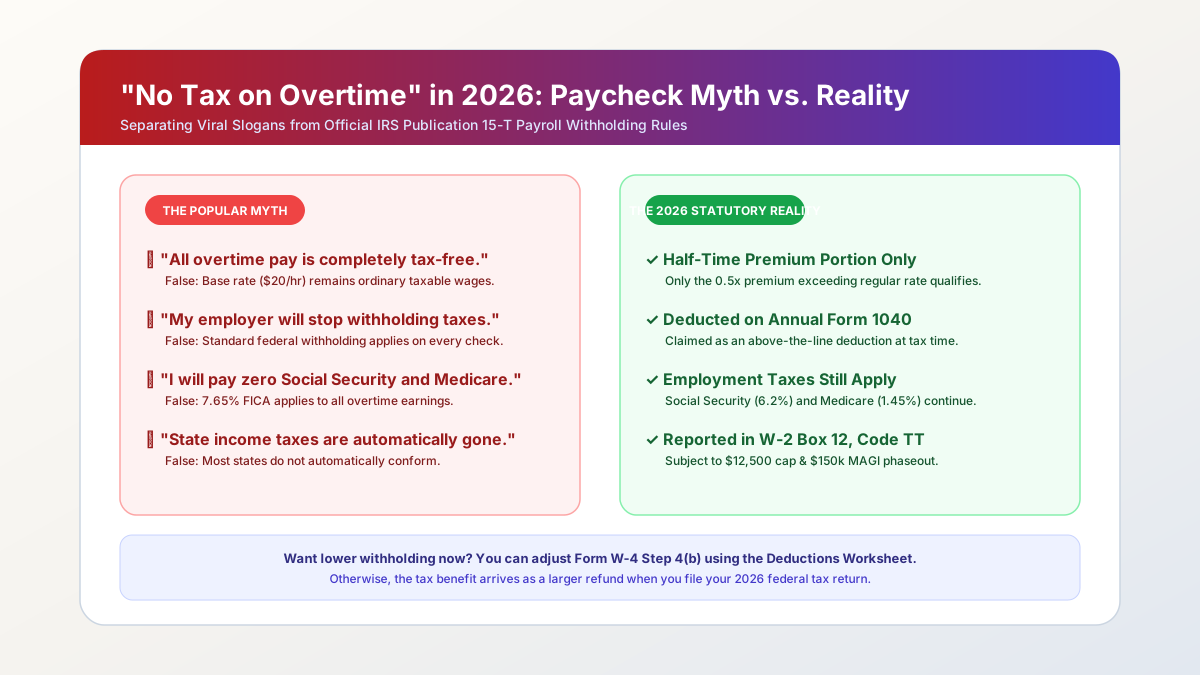
If you worked 15 hours of grueling overtime over the past two weeks, cracked open your pay stub expecting a massive paycheck, and saw hundreds of dollars sliced off for federal income tax, Social Security, and Medicare, you are not alone. Thousands of hourly nurses, factory technicians, line mechanics, utility workers, and warehouse employees are calling their payroll departments asking the exact same question: "Didn't Congress pass a law eliminating taxes on overtime in 2026? Why is my employer still taking taxes out of my check?" The short answer is that the law did pass, but it is not what social media soundbites made it out to be. There is indeed a federal qualified overtime deduction for tax years 2025 through 2028, but it does not make overtime pay instantly tax-free on payday. The tax deduction is structured as an above-the-line adjustment claimed on your annual tax return (Form 1040 Schedule 1-A), it applies only to the extra "half-rate" overtime premium under federal labor standards, and it does not touch payroll taxes like Social Security and Medicare. This guide breaks down the legal and computational mechanics of IRS FS-2026-13, explains why your employer is required by law to withhold taxes, and shows you how to adjust your Form W-4 to capture those tax savings every payday instead of waiting for a tax refund next spring.
Calculate Your Take-Home Pay
Enter your salary, state, and deductions — get your estimated net pay in under 100ms.
The Paycheck Shock: Why Overtime Isn't Free of Taxes on Payday
The frustration felt by American hourly workers in 2026 stems from a profound disconnect between political rhetoric and the administrative mechanics of federal tax law. Campaign slogans and sensational news headlines promised "no tax on overtime," leading millions of workers to expect that every dollar earned beyond 40 hours a week would land directly in their checking account without a single penny deducted.
When workers inspect their 2026 pay stubs, however, they discover that their gross overtime earnings are still being clipped by federal withholding, state withholding, and mandatory FICA payroll contributions. Many assume their employer's payroll software is defective or that their HR department failed to update company tax tables.
In reality, your payroll department is following strict statutory mandates codified in IRS FS-2026-13, IRS Form W-2/W-3 Instructions (2026), Schedule 1-A/Form 1040 Instructions, and applicable statutory provisions. The 2026 overtime tax benefit was enacted as an income tax deduction, not a payroll tax exemption. In the United States tax system, income taxes and payroll taxes operate under completely separate titles of the Internal Revenue Code. Furthermore, the deduction is administered as an above-the-line deduction reconciled on your personal tax return. Your employer cannot simply decide to turn off withholding on your overtime shifts without violating IRS regulations.
The FICA Rule: Social Security & Medicare Taxes Are Not Exempt
The first and most critical fact every worker must understand is that the 2026 overtime tax deduction has zero effect on payroll taxes.
In August 2026, the Internal Revenue Service published IRS FS-2026-13 to clear up confusion regarding employment tax withholding. The IRS issued an unambiguous determination:
Overtime compensation generally remains subject to applicable Social Security and Medicare taxes; the qualified-overtime deduction does not exempt the overtime wages from employment taxes.
Under the Federal Insurance Contributions Act (FICA), every dollar you earn as an employee is subject to two mandatory payroll taxes:
• Social Security Tax (6.2%): Deducted from all wages up to the 2026 annual statutory wage base of $181,800.
• Medicare Tax (1.45%): Deducted from all wages without any annual dollar ceiling.
Together, these two taxes equal a flat 7.65% employee contribution (matched by another 7.65% paid directly by your employer). If you earn $600 in overtime pay during a biweekly pay period, your employer is legally required under federal law to deduct $45.90 ($37.20 for Social Security and $8.70 for Medicare) regardless of any income tax deductions.
For high earners, the 0.9% Additional Medicare Tax also continues to apply to all combined compensation exceeding $200,000 for single filers or $250,000 for married couples filing jointly. FICA taxes fund trust funds for current retirees and healthcare beneficiaries; Congress did not grant any exemption from these payroll taxes when establishing the overtime deduction.
Why Automated Payroll Still Withholds Federal Income Tax
If the 2026 overtime deduction reduces federal income taxes, why does your employer still take federal income tax out of your overtime wages?
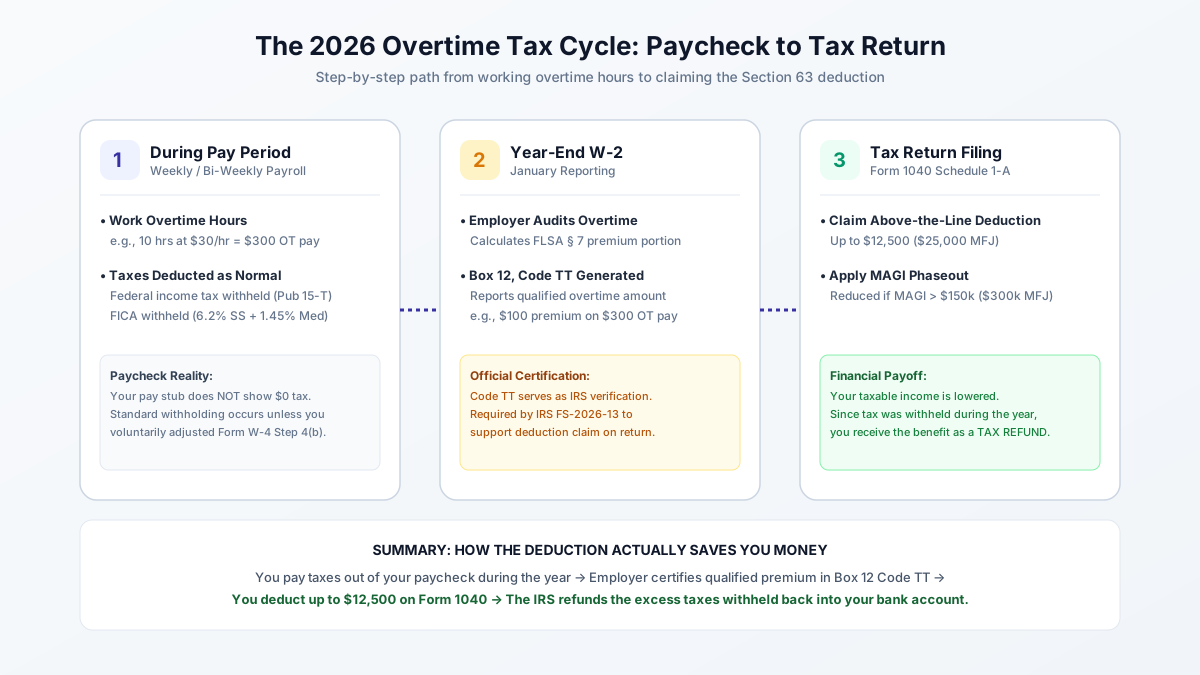
The reason comes down to how corporate payroll systems operate under IRS Publication 15-T (Federal Income Tax Withholding Methods). Payroll systems run automated computational algorithms on every single pay period in isolation. When processing your biweekly or weekly check, the payroll software looks only at your gross taxable pay for that period and the instructions you provided on your Form W-4.
Your employer's payroll system cannot predict your full-year financial life. Specifically, the payroll computer has no way of knowing:
1. Whether your annual overtime will exceed statutory caps: The deduction is strictly capped at $12,500 for Single/Head of Household filers and $25,000 for Married Filing Jointly.
2. What your year-end household income will be: The deduction phases out completely if your Modified Adjusted Gross Income (MAGI) exceeds $275,000 for single filers or $550,000 for joint filers.
3. What your spouse earns: If you are married, your spouse's income could easily push your household into the phaseout range.
4. Whether you will file jointly or separately: Married workers filing separately are legally disqualified from taking the deduction.
Because an employer cannot know these critical personal tax factors, IRS Publication 15-T requires employers to continue withholding federal income tax on overtime wages using standard annualized withholding tables or supplemental wage flat withholding (22%). If an employer stopped withholding income tax and you ended up ineligible due to spouse income or high MAGI, you would face severe underpayment penalties at tax time.
Instead, the IRS designed the system to reconcile annually. Your employer tracks your qualified overtime throughout the calendar year and reports it in Box 12 of your Form W-2 using Code TT. When you file your annual return, you report that Box 12 Code TT figure on Form 1040 Schedule 1-A, which applies the deduction and issues your tax savings as a refund.
State Overtime Pitfalls: Daily Overtime and Non-FLSA Hours
If you live in a state with protective labor laws, you must navigate an additional jurisdictional trap. Several states mandate overtime pay under circumstances where federal law does not.
For example, California Labor Code § 510 mandates overtime pay for any work performed beyond 8 hours in a single workday, regardless of total weekly hours. California, Alaska, and Nevada also enforce daily overtime thresholds, and many union agreements require premium pay for working weekends, holidays, or consecutive shifts.
In IRS FS-2026-13, the IRS established a strict jurisdictional test:
State-law overtime that is not required by FLSA does not qualify merely because state law labels it overtime. Analyze the actual FLSA-required portion separately.
Consider an equipment technician in Los Angeles who works a single 12-hour shift on Tuesday and zero hours the rest of the week. Under California law, the employer must pay 8 hours of regular pay and 4 hours of daily overtime. However, under federal FLSA rules, overtime is only mandated when total hours in a workweek exceed 40. Because the technician only worked 12 total hours in the workweek, none of the 4 daily overtime hours were required by federal law. As a result, zero dollars qualify for the federal overtime tax deduction.
Only hours worked beyond 40 in a single standard workweek satisfy Section 7 of the FLSA. Any state-specific premiums, holiday double-time, or weekend incentive differentials that occur within the first 40 hours of a workweek do not qualify for Box 12 Code TT reporting or the federal deduction.
Paycheck Comparison Table: Default vs. Adjusted W-4
To understand how these numbers translate to real-world cash flow, examine the table below comparing the biweekly paycheck of an hourly worker earning $30/hour who logs 10 hours of FLSA overtime per pay period (260 overtime hours annually).
The table compares three distinct scenarios:
1. Default Paycheck: Standard W-4 with default withholding (no adjustments).
2. Adjusted Paycheck: W-4 with Step 4(b) adjusted to reflect projected annual overtime deductions.
3. Year-End Reconciliation: The true net financial position after filing Form 1040.
How to Adjust Form W-4 Step 4(b) to See Savings Every Payday
You do not have to wait until April of next year to see the financial benefits of your overtime shifts. If you work predictable overtime hours throughout the year, you can instruct your employer to reduce your per-paycheck federal withholding right now by submitting a revised Form W-4.
Here is the exact step-by-step strategy:
### Step 1: Calculate Your Estimated Annual Overtime Premium
Review your historical pay stubs to estimate how many FLSA overtime hours you expect to work across the 2026 calendar year. Multiply those estimated hours by your 0.5x overtime premium rate.
• Example: 200 overtime hours per year × $15.00 premium = $3,000.00 annual qualified premium.
• Ensure your total does not exceed the statutory cap ($12,500 Single / $25,000 MFJ) and that your household MAGI will not exceed the $150,000 / $300,000 phaseout thresholds.
### Step 2: Enter the Dollar Amount on Form W-4 Step 4(b)
Obtain a 2026 Form W-4 from your employer or payroll portal. Navigate to Step 4(b) (Deductions).
• Enter your estimated annual deduction (e.g., $3,000) on Line 4(b).
• When your payroll department enters this value into their software, IRS Publication 15-T instructs the system to reduce your annualized taxable wages by $3,000 before computing withholding.
• For a worker in the 22% bracket paid biweekly (26 paychecks), this reduces withholding by roughly $25.38 per paycheck, placing that cash directly into your bank account every two weeks instead of lending it to the federal government interest-free.
### Step 3: Verify Your Withholding with Our Paycheck Calculator
Before submitting your form, run your numbers through our [Hourly Paycheck Calculator](/calculators/hourly) and read our comprehensive [Form W-4 Withholding Guide](/resources/w4-withholding-guide-2026). If your overtime hours fluctuate or you stop working overtime later in the year, remember to submit an updated Form W-4 removing the Step 4(b) entry so you do not under-withhold taxes.
Warning
Do not enter your total overtime wages on Form W-4 Step 4(b). Only enter the 0.5x overtime premium portion that qualifies under FLSA Section 7. Entering your full overtime pay will lead to severe under-withholding and an unexpected tax bill when you file your return.
Frequently Asked Questions
Because FICA employment taxes are legally separate from federal income taxes. In IRS FS-2026-13, the IRS confirmed that overtime compensation generally remains subject to applicable Social Security and Medicare taxes; the qualified-overtime deduction does not exempt overtime wages from employment taxes. All employees must contribute 6.2% for Social Security (up to $181,800 in 2026) and 1.45% for Medicare on every dollar earned.
Calculate Your Take-Home Pay
Enter your salary, state, and deductions — get your estimated net pay in under 100ms.
Related Articles
Paycheck Guides
What Is a Paycheck Calculator?
A paycheck calculator shows you exactly how much you take home after federal, state, and FICA taxes are withheld from your gross salary.
Read articlePaycheck Guides
Monthly vs Biweekly Pay — Which Is Better?
Biweekly pay means 26 paychecks/year (two months have 3 paychecks). Monthly pay means 12. The math affects budgeting and tax withholding.
Read articlePaycheck Guides
Biweekly Paycheck Calculator: What You Actually Keep in 2026
Biweekly pay means 26 checks a year — two months get three paychecks. Here's exactly how biweekly withholding works and what you keep at every salary level.
Read articleGet Salary & Tax Tips
Weekly insights on pay, taxes, and maximizing your take-home.